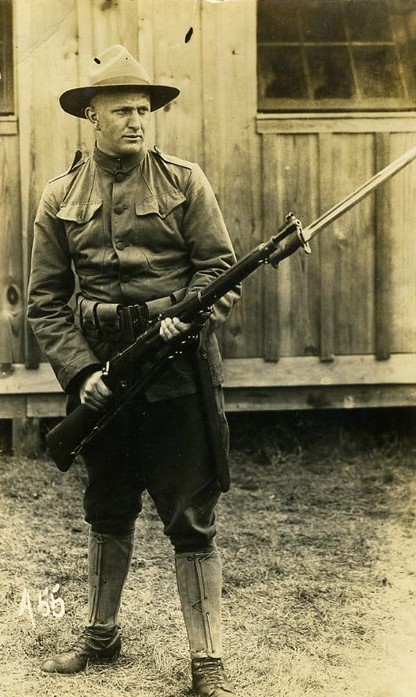
Granduncle J. Edward Johns fights in WW1
c. 1910s, photograph, extant
Added: 2026-09-05
Updated: 2026-09-05
Curator: John
Owner: John
People: J. Edward Johns Jr.
Places: Ohio
My dad’s uncle, John Edward “Ed” Johns, Jr., was an absolute badass.
During World War I, he served as a Second Lieutenant in the Machine Gun Company, 26th Infantry Regiment, 1st Division of the American Expeditionary Forces (A.E.F.).
Long before he got to Europe, Ed was already answering the call. While studying at Mount Union College in Ohio, he interrupted his education to join the Officers’ Reserve Corps. He trained at Fort Benjamin Harrison in Indiana, preparing for a war that America was increasingly likely to enter.
I don’t know yet what Ed actually did on the battlefield. His individual wartime story seems to have been lost to time. But his unit tells us something.
The 26th Infantry Regiment, the “Blue Spaders,” was part of the 1st Division, the first American division to arrive in France. Ed was in a machine gun company, so he wasn’t exactly sitting somewhere safely behind the lines. He would have been right in the middle of America’s first major combat operations of the war.
And Ed wasn’t the only one.
He went overseas as part of a group of brothers and cousins who served in the military:
- William P. Johns (brother) — Company L, 331st Infantry Regiment
- Homer M. Johns (brother) — 25th Engineer Regiment
- Armstrong Crawford (cousin) — Artillery
- William Wagoner (cousin)
- Warren Johns (cousin)
- Melville John (cousin)
After the war, Ed came home and joined his father in the family insurance business in the 1920s.
Then things got very Capra-esque.
At some point, Ed’s aging father either lost or embezzled a very large sum of money owed to the parent insurance company. I’m still trying to piece together exactly what happened. Whatever the details, it was the kind of financial disaster that could have destroyed the business and badly damaged the family’s reputation.
And this is where Ed’s story gets really interesting. Rather than let his father go down with the business, Ed quietly approached the parent company and negotiated a payment plan. Then he spent the next thirty years paying it off.
Thirty freaking years!
There was no grand gesture. No dramatic courtroom scene. No newspaper headline (or none found yet). Just Ed, year after year, working to make good on a debt that wasn’t even his. Eventually, he paid the whole thing off. That’s the part that makes me think of George Bailey. Not because Ed was some saintly fictional character, but because there’s something very “Capra” about a person whose heroism consists of simply refusing to walk away when shit gets bad. Ed went to war when his country needed him. Then he came home and spent three decades cleaning up a family crisis that wasn’t his fault.
The first kind of heroism is easier to recognize.
The second might be the more impressive one.
Final note:
Before Ed sailed for France during World War I, his father gave him the address of Mrs. Mary Jewell in Penzance, Cornwall, England, the sister of his grandfather John Johns.
In 1958, Ed came across that old address and sent a Christmas card to “The Family of Mrs. Mary Jewell.” He was hoping it might reach someone from his grandfather’s family.
It did, but the reply came from Johannesburg, South Africa.
That Christmas card opened the door to a whole branch of the family Ed didn’t know existed. It led to years of letters, photographs, and eventually a visit from one of his South African cousins.
It turns out the Johns family, originally from Cornwall, England, had scattered around the world after the tin and copper mines ran out. There were Johns relatives in Canada, Australia, South Africa, and elsewhere.
Ed and his wife Ester began piecing the family back together. Ester, in particular, became deeply involved in the project, corresponding with relatives overseas and gathering old letters, newspaper stories, cemetery records, family histories, photographs, and maps. My father’s love of geneaology began here as well.
The result was a bespoke bound family history, completed in the early 1970s, just after Ed’s death: The Descendants of William Johns and Jennifer Blight Johns.
All of it started with a Christmas card.
I am proud to mention that the book is part of the Mormon’s Family Search library, located in Salt Lake City, Utah.